

Leverage the Power of the World’s Most Influential Teaching Framework
Viewed and Downloaded 147,000+ Times by Teachers Around the World
🎯 Fully take advantage of the power and scope of Bloom’s Taxonomy.
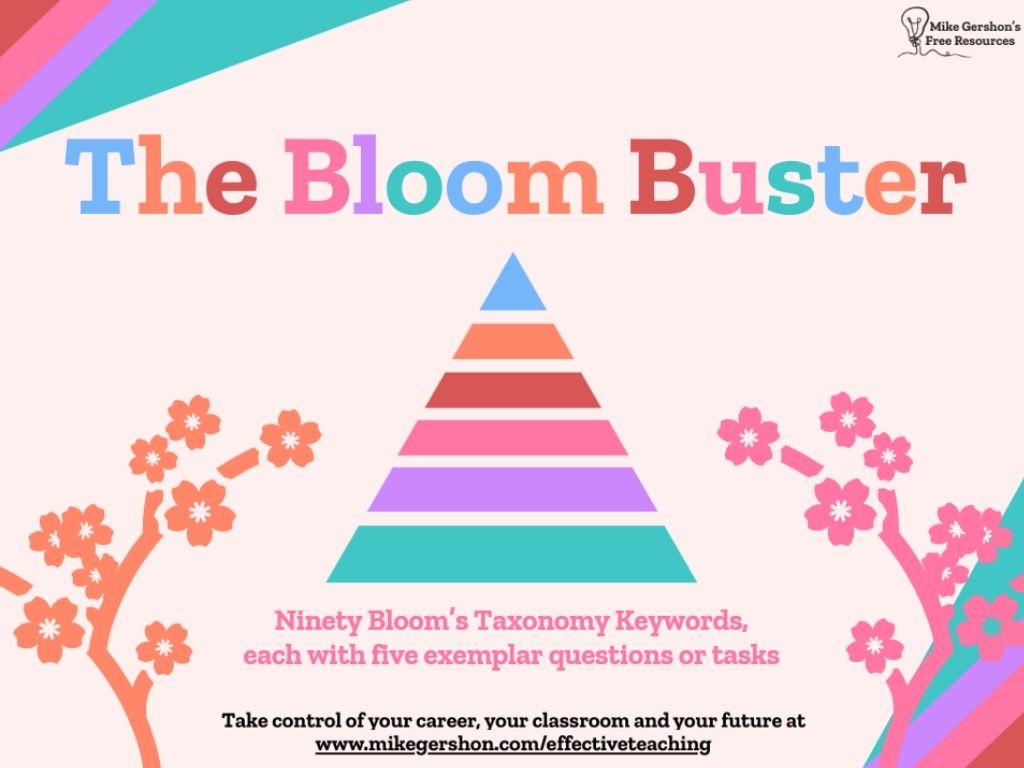
🎯 90 keywords, covering all six levels, with 450 exemplar questions and tasks.
🎯 Suitable for primary and secondary.
🎯 Simplify your planning, vary the focus of your lessons, and weave challenge into any activity.
🎯 Master the taxonomy and unlock its benefits for the learners you teach.
Bloom’s Taxonomy is over half a century old, yet it still reigns supreme as the most influential teaching framework around.
For proof, just look at pretty much any mark-scheme constructed by any exam board, and most of the curricula that teachers and schools are asked to teach.
You’ll see the fingerprints of the taxonomy.
Why is it so influential?
Because it orders and categorises the key cognitive processes that form the bedrock of learning in logico-linguistic subjects.
Which is most of the curriculum.
In short, Bloom’s Taxonomy sits at the very heart of everything we do.
(If you teach a practical area of the curriculum, Bloom’s has relevance. But so does another type of taxonomy. That of the psycho-motor domain, which is concerned with the development of practical mastery.)
One of the Easiest Ways to Master the Taxonomy
When I built The Bloom Buster, I focussed on two things.
Digging deeper into Bloom’s.
And making the taxonomy easy to use – for myself, and for other teachers.
Inside the resource, you’ll find the six levels of the taxonomy:
- ✅ Knowledge
- ✅ Comprehension
- ✅ Application
- ✅ Analysis
- ✅ Synthesis
- ✅ Evaluation
For each level, there are fifteen keywords. Synonyms referring to subtly different ways of thinking.
For each keyword, I’ve created five exemplar tasks and questions.
Giving you 450 in total.
Plenty to get your teeth into, and to use to make your planning easier, simpler and more enjoyable.
The resource is FREE to download and FREE to use.
It is published by Gershon Learning Limited under the CC BY-NC-ND 4.0 Creative Commons license.
That means you can download it, freely share it and redistribute it with attribution and a link to this site, but you cannot use it for commercial purposes or create any derivatives of it.
Download The Bloom Buster Today
Here’s the PDF version for you to download FREE:
What’s Inside?
Here’s a list of the six levels and some of the exemplified keywords waiting for you inside The Bloom Buster:
- 🎯 Knowledge: Arrange, Define, List, Name, Order, Repeat, Retain
- 🎯 Comprehension: Characterise, Classify, Discuss, Express, Illustrate, Sort, Translate
- 🎯 Application: Apply, Choose, Employ, Interpret, Perform, Sketch, Solve
- 🎯 Analysis: Analyse, Categorize, Differentiate, Examine, Investigate, Question, Test
- 🎯 Synthesis: Combine, Create, Devise, Hypothesise, Merge, Plan, Unite
- 🎯 Evaluation: Appraise, Critique, Defend, Grade, Justify, Rank, Value
Using The Bloom Buster in Your Planning
The Bloom Buster is non-directive and curriculum agnostic.
You can use the keywords, questions and tasks inside any way you like.
Here are five ideas to get you started.
✅ Use the evaluation and synthesis pages to quickly plan extension tasks and questions for your more-able learners (or, perhaps, for all learners in your class).
✅ Use the keyword banks at the start of each section to speed up your planning of lesson objectives and learning outcomes.
✅ Challenge yourself to develop a wider variety of tasks by focussing on keywords that you haven’t used before (there are 90 in total across the resource).
✅ Increase the level of challenge in existing lessons by going through your slides and tweaking tasks, activities and questions so they are based on keywords from higher levels of the taxonomy.
✅ Scaffold learning and create success for learners who are struggling by developing concrete questions using the knowledge and comprehension sections of the resource.
P.S. You can access all my resources in one place on the free resources hub page.
P.P.S. Discover dozens of Bloom’s Taxonomy guides, strategies and techniques at my free Bloom’s Taxonomy Knowledge Base.


