
Mike Gershon’s INSET, Training and CPD
Stretch and Challenge for More-Able Learners

The New Way to Make Stretch and Challenge the Norm for More-Able Learners Across Your School, Without Increasing Workload
- ✅ Find out why the more-able are at risk of becoming the bored-able in classrooms up and down the country, and why making subtle, yet significant, changes to lesson planning can instantly ensure this fate never befalls any of the more-able learners in your school.
- ✅ Discover the three essential ideas that, when brought together, give teachers the insights required to understand stretch and challenge from the perspective of their more-able learners, making it easier and simpler to meet their needs in every lesson.
- ✅ Learn how to leverage the power of Bloom’s Taxonomy to plan tasks and develop extensions that are GUARANTEED to be challenging, engaging and stimulating for more-able learners who whizz through their work far quicker than their peers.
- ✅ Unlock the questioning strategies that allow teachers to immediately increase the level of challenge for their more-able learners, pushing them to step out of their comfort zone and think at a level that helps them make rapid and sustained progress.
- ✅ Give your staff the chance to have their thinking stretched and challenged as they try out seminal stretch and challenge strategies for themselves. Watch as they connect these experiences to their own classrooms and find ways to quickly increase challenge for the more-able learners they teach.
When the more-able become the bored able – that’s when we know we have a problem.
It’s a phrase that was coined some years ago, but which has stuck.
The bored able.
Why do they end up that way?
Why do some of our most-able learners wind up demoralised and disinterested?
Usually, because they are asked to do more of the same, instead of something more challenging.
And this can happen in any classroom, primary or secondary.
Imagine a more-able learner finishes some comprehension work before their peers, in a primary literacy lesson.
The teacher gives them some more comprehension work to do, to keep them busy.
- 😴 More of the same.
- 😴 To keep them busy.
That is a recipe for switching off.
For deciding to take longer than you need to complete your work in the future.
For not fulfilling your potential.
Imagine a more-able learner in a secondary school who has that kind of experience repeatedly, in different lessons.
It brings to mind the old PlayStation 2 advert, where a circus of fleas are kept inside a glass jar for three days.
When the lid is removed, the fleas will not jump any higher than the top of the jar.
They’ve been conditioned by their environment into only going so far.
And no further.
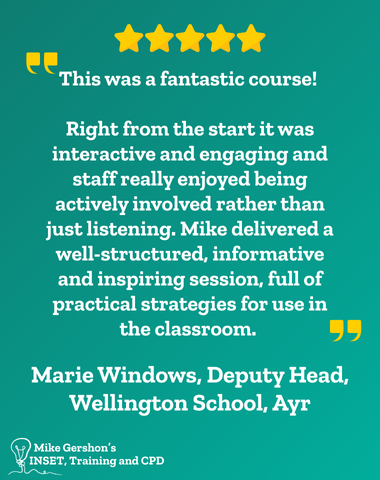


Tap Into Mike’s 10+ Years of Helping Schools Engage, Enthuse and Motivate Their More-Able Learners
Every teacher can get their hands on the tools necessary to consistently stretch and challenge their more-able learners.
That’s what we focus on in the training.
Ensuring that your teachers have the strategies and techniques they need.
So they can tweak their planning and adapt their teaching, making sure their more-able learners always have an interesting challenge or perplexing question they can get their teeth into.
This is about creating a new normal for more-able learners.
One in which they come to expect high challenge, and enjoy the experience of pushing back the boundary of what they thought they could do.
Whenever I deliver Stretch and Challenge for More-Able Learners, I like to begin by asking colleagues to think about the more-able learners they teach.
- 🎯 What makes them stand out?
- 🎯 How are they different from their peers?
- 🎯 What sets them apart?
This is important.
It helps to contextualise the ideas we explore at the start of the training.
Because, when it comes to stretching and challenging more-able learners, we’re never thinking about the general, but always about the specific.
Those specific learners in your school who are more-able than their peers.
There might be a few of them, there might be a lot of them.
But it’s these individuals on whom our training focuses.
And we carry that theme throughout the day.

Taking this approach means colleagues have the more-able learners they teach at the top of their minds throughout our time together.
This has two benefits.
First, it ensures we are always thinking about individuals, and how we can use stretch and challenge to help specific learners realise their potential and push back the boundaries of what they think is possible.
Second, it means staff get a head start on modifying and adapting the strategies I share, moulding them to the specific needs of their more-able learners.
This, combined with the time we spend on implementation, helps ensure your teachers are ready to hit the ground running as soon as the training is over.
Primed to introduce new techniques and adapt their planning in the days, weeks and months ahead.
All for the benefit of those more-able learners they teach.
At the start of the day, I share some key ideas we can use to understand what stretch and challenge looks like for more-able learners, and what it feels like from their perspective.
These conceptual tools are crucial for developing and enhancing how your staff think about stretch and challenge.
I also like to share a delineation of the differences between more-able learners and ‘gifted’ learners.
This always sparks intense discussion.
And gives staff a real insight into the subtle distinction between these two closely connected, but different, groups of learners.
Then, we move onto practical strategies, including:
- 🎯 An approach to questioning that transforms how the game works, getting more-able learners into the position of having to continually justify, explain and develop their thinking, rather than just provide the right answer.
- 🎯 A technique that makes it as easy as pie to come up with highly challenging questions in the moment, without having to do any planning or preparation. You can even flip the strategy round and get your more-able learners to use it for creating challenging questions of their own.
- 🎯 How to think about the language of Bloom’s Taxonomy in a way that opens up the range of possible tasks and questions you can plan for your more-able learners, ensuring they always have something interesting, challenging and engaging to get stuck into.
- 🎯 Why focussing on novel scenarios can be a gamechanger for stretching and challenging more-able learners in practical settings, and how the idea of articulation is at the heart of this approach.
- 🎯 A hugely fun activity you can use as a main task, starter or extension that immediately gets your more-able learners thinking in depth about an idea they may well have never considered before, but which they now must justify without holding back.
Secure Mike’s ‘Stretch and Challenge for More-Able Learners Training’ for Your Staff Now
Or CALL NOW to secure your dates on 0333 404 7259
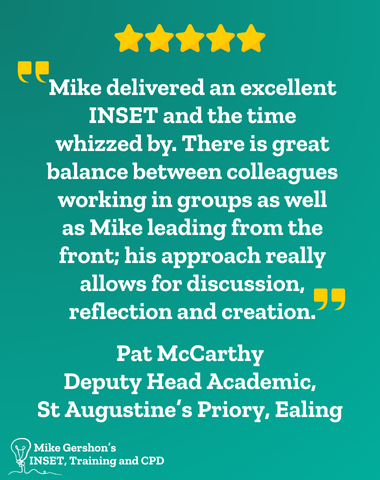


Inspire Staff to See How Simple, Practical Strategies Can Help Them Unlock High Challenge for All Their More-Able Learners, in Every Lesson They Teach
A full-day with Mike gets your staff thinking critically about stretching and challenging their more-able learners.
Packed with key ideas and practical strategies, Mike’s training gives your teachers the tools they need to develop their practice.
Here’s an example of a full-day schedule:
- 9.00 – 10.30: Session 1 – What does it feel like to be stretched and challenged?
- 10.30 – 11.00: Break
- 11.00 – 12.30: Session 2 – Practical Strategies for Challenging Your More-Able Learners
- 12.30 – 13.15: Lunch
- 13.15 – 14.30: Session 3 – Implementation Team Working
- 14.30 – 14.45: Optional Break
- 14.45 – 15.15: Session 4 – Sharing Practice, Reflective Plenary
In Session One, we do three things:
- 🎯 Think about our existing experience of working with more-able learners, and use this to help analyse and reflect on the subtle differences between more-able and ‘gifted’ learners.
- 🎯 Explore three key ideas every teacher needs to know if they want to make sense of stretch and challenge for more-able learners from their own perspective, and from the perspective of their learners.
- 🎯 Examine the nature of questioning, think about how this connects to our more-able learners, and start looking at practical strategies any teacher can use to increase the level of challenge in their classroom.
Session Two has an entirely practical focus, building on the work we do in Session One.
Together, we’ll cover:
- 🎯 The role of Bloom’s Taxonomy in planning for more-able learners, including how we can use the language of Bloom’s to ensure our more-able learners always have something more challenging to work towards.
- 🎯 Multiple examples of how we can use Bloom’s Taxonomy, and the taxonomy of the psychomotor domain in practical areas of the curriculum, to set a consistently high level of challenge for our more-able learners.
- 🎯 An inspiring collection of evaluation and synthesis activities that are fun, challenging and highly engaging for more-able learners, all of which can be modified and adapted for use across the curriculum and with different age groups.
Implementation is Key
After lunch, we get colleagues into teams, working on implementation.
For me, this is crucial.
Staff need the opportunity to translate the ideas and techniques from the morning into their own practice.
While this is happening, I circulate, spending time with each team in turn.
It’s incredible just what colleagues can produce in this timeframe. The quality and depth of work I’ve seen teams create is remarkable.
I always encourage one or more senior leaders to come round with me as I circulate, so they can get a sense of what staff are developing.
Finally, we have the reflective plenary.
I bring everyone back together and teams have the opportunity to share their work with each other in a supportive, collegial atmosphere.
This creates great momentum to carry into the next full week of teaching, and beyond.
It ends the day on a high, and gives staff the confidence and energy to drive forwards with the new ideas, strategies and materials they’ve created.
What is included in a full day of Stretch and Challenge for More-Able Learners INSET, Training or CPD?
All bookings include:
- ✅ A full day of CPD, as outlined above, with the option to tailor sessions and messages to match the current priorities of your school.
- ✅ Full access to all resources used on the day, including copies of the slides for internal use.
- ✅ The right to film the training and to subsequently store and share this within your school.
- ✅ One-to-one SLT support, either on the day or via TEAMS/phone, in which Mike will walk you through proven strategies for maintaining momentum around stretching and challenging more-able learners for 12+ months after the training is finished.
- ✅ A dozen copies of my bestselling book 50 Quick Ways to Stretch and Challenge More-Able Learners, to share with staff.
For half-day and twilight INSET or CPD, we focus on the expert-led sessions from Mike, and remove the implementation and plenary sessions from the agenda.
Everything else listed above is included in half-day and twilight bookings.
One input from Mike and, if you follow his guidance on how to maintain momentum around developing stretch and challenge for more-able learners, you’ll have scope for 12+ months’ sustained impact in your school.
Plus, an exclusive bonus to celebrate the launch of my newly developed CPD platform, Mike Gershon’s Effective Teaching and Learning.
- ⭐ All full-day courses booked in 2026 will receive three complementary one-year memberships to the platform, worth £1,966.
- ⭐ Choose any three members of your school’s leadership team to receive these memberships.
- ⭐ They will gain access to everything on the platform for a full twelve months, including thirty courses covering ten key areas of teaching and learning, practical guides, big picture videos, a growing webinar library, and resources covering how to support ASD learners in mainstream classrooms.
- ⭐ Over 3,000 teachers were part of the first version of the platform. Version two provides a bigger, better, more intuitive experience that three members of your leadership team can enjoy as part of this exclusive, time-limited celebration.
- ⭐ Key areas covered on the platform include Feedback, Metacognition, Differentiation, Scaffolding and Modelling, Independent Learning, Assessment for Learning and more.
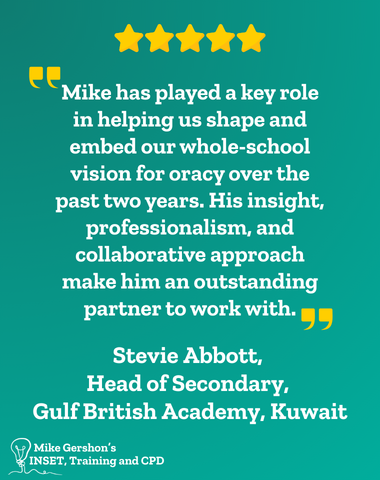
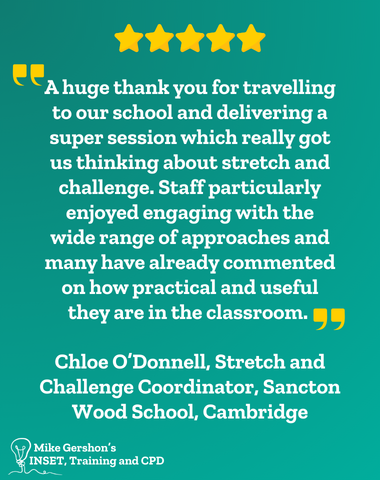
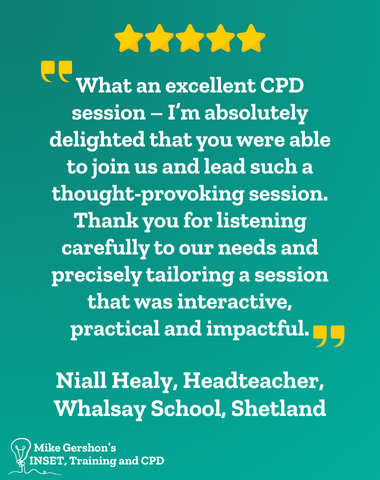
World-Leading Expertise on Practical Teaching and Learning That Works
Five reasons you can rely on Mike to deliver expert training and practical guidance for your staff.

- ✅ Mike has worked with more than 700 schools, delivering inspiring in-person training to over 35,000 teachers.
- ✅ Mike is the author of forty books on teaching and learning, including numerous bestsellers, that have sold in excess of 160,000 copies worldwide.
- ✅ Mike’s teaching resources have been viewed and downloaded more than 4 million times by teachers in over 180 countries and territories.
- ✅ Mike has been working with schools, governments and regional authorities continuously since 2010.
- ✅ Mike has supported over 3,000 teachers online through his bespoke CPD platforms, including Mike Gershon’s Effective Teaching and Learning, the only professional development platform built on Mike’s expertise and prioritising teacher autonomy.
Frequently Asked Questions
Do you do half-day and twilight training?
Yes. I offer both and recognise the flexibility schools sometimes need around their calendars. Half-day and twilight CPD focuses on expert input from me. We remove the teamworking and plenary sessions to accommodate this.
Do you offer follow-up packages?
Yes. Many schools I work with ask me to come back and work with them again, to support them in their developmental journey. Follow-up options include further training, supportive observations with constructive feedback, paired observations and SLT coaching.
We’re a small primary school, can we still work with you?
I always hold back a few dates each year for small primaries, recognising the challenges the smallest schools face in accessing high-quality training. We can also work around tight budgets by looking at online options and in-person training involving multiple schools. The smallest primary I’ve worked with had four teachers – and we had a great day together!
We’d like to look at online training. Is that something you offer?
Yes. It is not my preference as I believe that in-person is always better, and includes elements that can’t be replicated online. However, I do provide online training for schools where in-person may be difficult due to geography, time zones and other factors. My one rule for online is that staff must sit together so that I can facilitate discussion and interaction just as I do when delivering in person.
How far are you willing to travel?
I travel across the UK and overseas from my base in York. Far flung visits have included Shetland, Cornwall, Scotland, Northern Ireland and Pembrokeshire. Even further flung visits have included Romania, Norway, Italy, Bahrain, Kuwait and The Falkland Islands. Trips that require extensive travelling attract a higher cost to cover additional time and mileage.
Can we book you in conjunction with another school?
Yes. Many smaller schools opt for this approach. Sometimes this sees two or three primaries joining up for a full-day session, sometimes a cluster of schools combine budgets and I work with them over an extended period. Occasionally schools ask if they can book me and then sell tickets to the event to nearby schools to cover costs. That is also fine with me.
Is the training relevant for all age groups?
Yes. I have worked with hundreds of primaries, hundreds of secondaries, and dozens of FE colleges over the years. I present in a curriculum agnostic way, using examples that are relevant for the audience in front of me and the age group they teach. A big part of all my training is giving colleagues the opportunity to think about how they can take the ideas and strategies I present and use them with the learners they know best.

Start Changing Your Staff’s Approach to Stretching and Challenging More-Able Learners Today With Mike’s FREE Bloom’s Taxonomy Knowledge Base
Get a head start on developing how you stretch and challenge more-able learners in your school by exploring my Bloom’s Taxonomy Knowledge Base and sharing it with your staff.

The Knowledge Base features 42 blogs and articles adapted from my bestselling book How to Use Bloom’s Taxonomy in the Classroom: The Complete Guide.
Many of the blogs focus on stretching and challenging more-able learners, particularly those that look at synthesis and evaluation, the top two levels of the taxonomy.
You’ll find guides, explanations and practical strategies covering:
- 🎯 Understanding Bloom’s Taxonomy
- 🎯 Knowledge, Comprehension, Application and Analysis
- 🎯 Synthesis and Evaluation
- 🎯 Developing Objectives and Outcomes
- 🎯 Planning Activities and Products
- 🎯 Bloom’s Taxonomy and Questioning
- 🎯 Using the Taxonomy in Assessment
- 🎯 Stretch, Challenge and Bloom’s Taxonomy
Plus I have another FREE bonus for you.
My Challenge Toolkit contains 50 strategies, activities and techniques you and your teachers can use to stretch and challenge all learners, including the more-able.
It’s been viewed and downloaded almost a quarter of a million times by teachers in the UK and around the world.
Secure your copy today to share with your staff and get a head start on developing stretch and challenge in your school.
Enjoy!
P.S. Don’t forget, when I deliver my Stretch and Challenge for More-Able Learners training, the emphasis is always on making life simpler and easier for your teachers, so they can adapt, develop and enhance their practice in ways that work.


