Mike Gershon’s Knowledge Base
The Differentiation Knowledge Base

Welcome to the Differentiation and Adaptive Teaching Knowledge Base
For me, differentiation is, and always has been, synonymous with adaptive teaching.
Differentiation is all the things we do to help learners make progress, regardless of their starting points.
That doesn’t mean we disregard their starting points.
Far from it.
But wherever those starting points are – high, low, or in the middle – differentiation is about the decisions we make while teaching, while planning and, to a slightly lesser extent, when assessing, that help learners access the learning, experience a good level of challenge, and make great progress.
Differentiation is therefore all the practical strategies, activities and techniques we use to personalise learning.
It’s an umbrella term.
A lens through which we look when making decisions about teaching and learning.
Not something we inject into lessons or tack on.
It includes things like questioning and giving feedback.
Why?
Because if we ask tailored questions and give personalised feedback, we are adapting our teaching to meet the needs of the learners in front of us.
And that is differentiation.
Sometimes an extra resource is useful.
But differentiation doesn’t march in lockstep with the creation of additional materials.
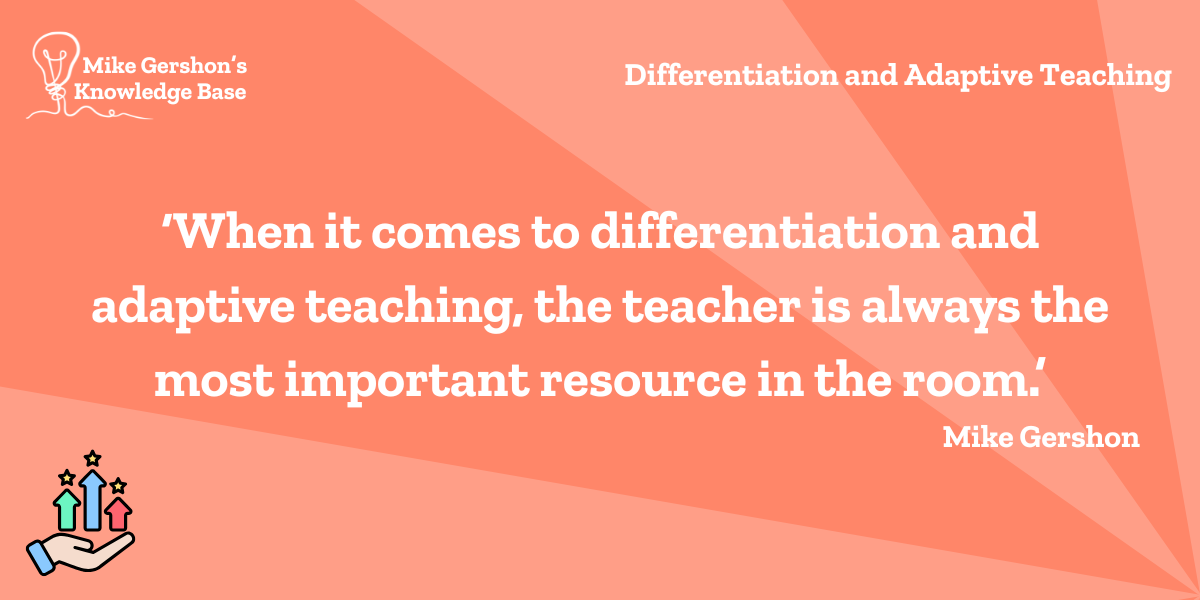
The teacher is always the most important resource in the room.
Because so much differentiation comes from what we do, based on our knowledge and understanding of the learners in front of us.
How we question, scaffold, model, explain, give verbal feedback and alter the pace of the lesson are all examples of this.
Some years ago, I developed a practical delineation that I call The Five Categories of Differentiation.
This helps us focus on different aspects of our practice and assess whether we are differentiating to the extent we want.
The five categories are as follows:
- ✅ Activities
- ✅ Questioning
- ✅ Things You Can Ask Learners to Do or Use (also called Self-Scaffolding)
- ✅ Things the Teacher Can Do or Use
- ✅ Words and Writing
These categories cover most of the practical strategies we call on as teachers to personalise learning.
While there is some overlap, the delineation helps us to think about different aspects of differentiation, and the work we do in the classroom.
Here, you’ll find 38 blogs, containing more than 100 strategies, covering these five categories.
For every strategy, I’ve included an explanation of how it helps you to differentiate.
Plenty for you to get your teeth into.
Most of the blogs are short, sharp and to the point.
Practical ideas you can quickly adapt and apply.
If you want to go deeper and develop your thinking further, you’ll find blogs and articles clustered together in groups.
Reading a group is like reading a chapter of a book, giving you scope to dig deep into a particular topic.
(Plus, another bonus for you. Now you can download my fully redesigned and updated FREE resource, The Differentiation Deviser. This has already been viewed and downloaded over 200,000 times by teachers around the world. It includes 80 strategies, activities and techniques you can use to differentiate. Even more to help you out in your planning and teaching.)

Navigate the Differentiation and Adaptive Teaching Knowledge Base

Differentiating Activities


Using Questioning to Tailor Your Teaching




Things You Can Ask Learners to Do or Use (Self-Scaffolding)



Things the Teacher Can Do or Use




Differentiating Words and Writing