
Mike Gershon’s INSET, Training and CPD
Stretching and Challenging All Learners
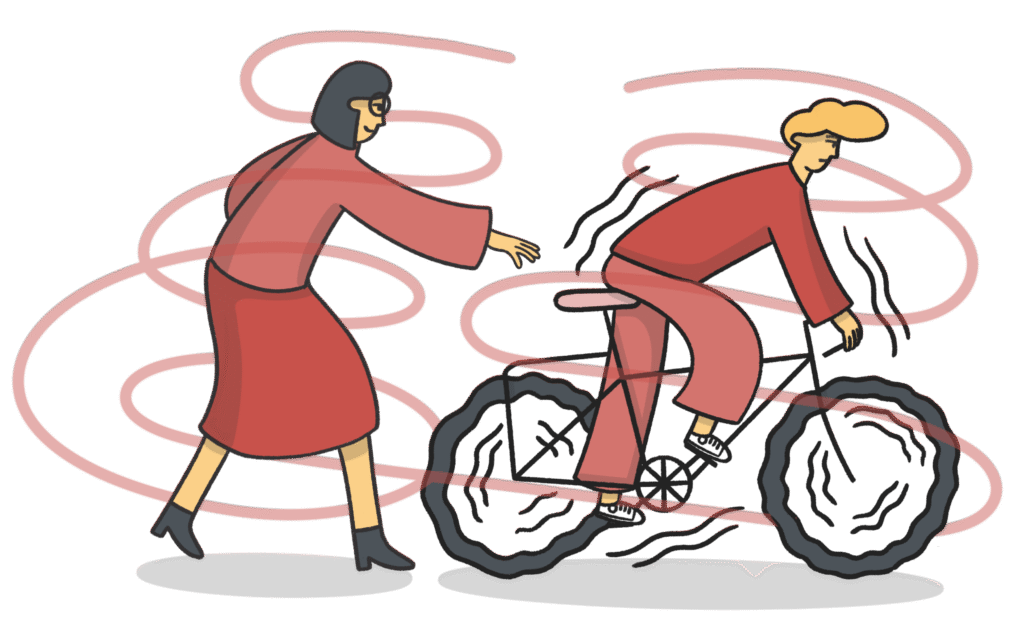
Transform How Your Teachers Think About Stretch and Challenge, and Give Them the Tools They Need to Start Pushing Learners’ Thinking Today
- ✅ Use Mike’s training to help your staff reappraise their relationship with stretch and challenge, so they look afresh at their planning, their teaching, and the way they use their professional decision-making to push learners’ thinking right up to the edge of what it’s possible for them to achieve.
- ✅ Explore the trio of key ideas Mike uses to help teachers think critically about the nature of stretch and challenge, as well as what it feels like from the learner’s perspective. These ideas provide a roadmap you can use across your school to support teachers as they focus on developing stretch and challenge.
- ✅ Unlock a series of powerful practical strategies designed to help teachers tailor their planning so that all learners can experience a high level of challenge, whatever their starting points.
- ✅ Discover why questioning has the power to both consistently embed stretch and challenge for every learner and prevent this from happening. Watch as Mike leads your staff in a critical reflection on the nature of questioning, and the secret questioning traps any of us can fall into, but which we must avoid if we want to sustain challenge in all our lessons.
- ✅ Give your staff access to Mike’s curated suite of stretch and challenge techniques. Techniques teachers can modify and adapt during the training, so they are ready to deploy them in their classrooms the very next day, for the benefit of every learner they teach.
When I was teaching, I used to love having multiple extensions on my slides.
First up was an extension, challenging learners to go beyond what they’d done in the main task.
When someone completed that, I’d reveal the Super Extension, which asked them to think about things from a different angle, or to think creatively about the topic.
And when someone completed that?
I’d reveal the Outer Space Extension.
In one lesson, we got all the way to the Edge of the Galaxy Extension.
There were two reason I did this.
First, I wanted to ensure learners who completed the main task always had something more challenging to tackle.
Second, to make stretch and challenge fun.
Desirable.
Something learners actively wanted to seek out.
And that’s what happened.
The extensions were always open to everyone, and I made that plain to the learners.
Anyone who finished the main activity before the rest of the class could move straight on to the extensions.
Sometimes I’d create new extensions on the spot, to keep upping the level of challenge.
That also meant giving a bit of extra time to learners who hadn’t yet completed the main activity, so they had a chance to get onto the first extension.
They could then feel part of it as well, and enjoy the pleasure of tackling a challenge they’d earned through their own efforts.
I think this is really what stretch and challenge is all about.
Finding strategies – and I share lots of them in the training – you can use to motivate and engage learners, so they see challenge as something that is for them, and something it is desirable to chase after.
Because if you can achieve that, the atmosphere it creates, and the culture it promotes, is hugely positive for every learner you teach.


Use Mike’s Expertise to Develop a Culture of Challenge in Your School Today
It’s always worth thinking about stretch and challenge from two perspectives.
The teacher’s.
And the learner’s.
This is how I like to start the Stretching and Challenging All Learners training.
So we can lay the groundwork for the practical strategies that follow.
From the teacher’s perspective, our focus is on what it means to stretch and challenge all learners in the context of mixed-ability teaching.
The aim is to find the sweet spot between stretching and challenging everyone in the room, and being able to do it sustainably, over an extended period.
Something that is both realistic and achievable, in any classroom.
From the learner’s perspective, we think about the psychological aspects of challenge, both good and bad.
I think this is really important.
Challenge is a good thing.
Something we use to set high expectations, help learners make great progress, and ensure everyone we teach has the best chance of unlocking their potential.
But we must remember that’s our perspective, as the teacher.
For learners, challenge can be fun, enjoyable, satisfying and rewarding.
Yet it can also be frustrating, stressful, awkward and, at times, off-putting.
Tackling this head on is key.
If we can think ourselves into learners’ mindsets, we can plan and present challenge so that it lands positively and has the impact we want.

So we start the training with a set of key ideas.
Ideas that help us think about stretch and challenge from our perspective, and from the perspective of our learners.
After that, and for the majority of the session, we focus on practical strategies teachers can use to weave stretch and challenge throughout their planning and teaching.
Together, we’ll explore three key areas, each of which gives us a different way into stretch and challenge for all:
- ✅ Questioning
- ✅ Bloom’s Taxonomy
- ✅ Scaffolding and Modelling
Questioning sits at the centre of teaching.
It drives learning in the classroom and is quite possibly the most common way through which teachers interact with learners.
Bloom’s Taxonomy is a personal favourite of mine (for more on which, see my Bloom’s Taxonomy Knowledge Base for lots of FREE material).
It retains its relevance today, many decades after it’s inception, because it focuses on the underlying fundamentals of how we think and learn.
And it offers huge scope for stretching and challenging all learners.
Particularly through how we plan and develop activities.
(Plus, I’ll share the taxonomy of the psychomotor domain with you and your staff. This is less widely known, yet is a far better option for embedding stretch and challenge if you are teaching practical topics or subjects.)
Finally, scaffolding and modelling lets us think about how we can help all learners access high challenge.
And it also gives us specific techniques we can use to target our less-able learners.
Helping them to embrace stretch and challenge in a way that works for them.
Some of the practical strategies we’ll look at on the day include:
- 🎯How to identify and neutralise the five most common questioning traps teachers fall into, all of which stop stretch and challenge dead in its tracks. Once you know what these are, questioning becomes a different process altogether.
- 🎯 Why you need to look afresh at scaffolding and start seeing it as a double-pronged approach. One through which you can increase the level of learner skill or decrease the level of challenge, depending on what’s happening in front of you.
- 🎯 How to use Bloom’s Taxonomy to plan activities that are inherently progressive, built around an increasing level of challenge that meets the needs of all the learners in your class, without adding to your workload.
- 🎯 Why you should start using stepped activities and why they are a powerful, simple way to increase the level of challenge for all learners, often requiring only subtle tweaks to your existing planning.
- 🎯 How to make sense of what is happening in less-able learners’ minds when the level of challenge gets too much for them, and the truly reliable scaffolding strategies you can use to bring these learners back into the learning.
Secure Mike’s Stretching and Challenging All Learners Training for Your Staff Now
Or CALL NOW to secure your dates on 0333 404 7259
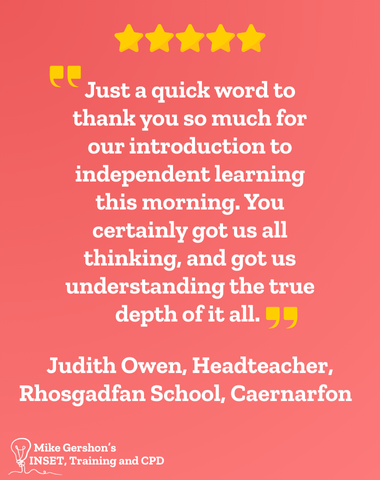
Create Certainty for Your Staff Over What Stretch and Challenge Looks Like, How to Weave it Through Planning, and Why it Matters Now More Than Ever
A full-day with Mike gives your staff the insights, energy and motivation to bring stretch and challenge to life in their classrooms.
Here’s an example of a full-day schedule:
- 9.00 – 10.30: Session 1 – Stretch and Challenge for All
- 10.30 – 11.00: Break
- 11.00 – 12.30: Session 2 – Adapting Your Teaching and Modifying Your Planning
- 12.30 – 13.15: Lunch
- 13.15 – 14.30: Session 3 – Implementation Team Working
- 14.30 – 14.45: Optional Break
- 14.45 – 15.15: Session 4 – Sharing Practice, Reflective Plenary
Session One is where we begin, focussing on those key ideas teachers need to know, so they can think about stretch and challenge from their perspective, and from the perspective of their learners.
I’ll encourage colleagues to reflect on their own skills and experiences, as well as the strategies they already use to promote challenge in their classrooms.
This helps them to situate the new ideas I share within the context of their professional decision-making and expertise.
In the second half of Session One, we start to look at how we can shift the dial when it comes to planning for stretch and challenge, as well as what we can do to adapt learning in the moment, while we are teaching.
Session Two continues this theme, and I’ll share a host of practical strategies with your staff.
Strategies they can use in their own planning and teaching, and which they can tailor to meet the unique needs of their learners.
Across the morning, we’ll cover Questioning, Bloom’s Taxonomy and Scaffolding and Modelling.
Looking at how we can use each of these areas to embed stretch and challenge for all.
Implementation is Key
After lunch, we get colleagues into teams, working on implementation.
For me, this is crucial.
Staff need the opportunity to translate the ideas and techniques from the morning into their own practice.
While this is happening, I circulate, spending time with each team in turn.
It’s incredible just what colleagues can produce in this timeframe. The quality and depth of work I’ve seen teams create is remarkable.
I always encourage one or more senior leaders to come round with me as I circulate, so they can get a sense of what staff are developing.
Finally, we have the reflective plenary.
I bring everyone back together and teams have the opportunity to share their work with each other in a supportive, collegial atmosphere.
This creates great momentum to carry into the next full week of teaching, and beyond.
It ends the day on a high, and gives staff the confidence and energy to drive forwards with the new ideas, strategies and materials they’ve created.
What is included in a full day of Stretching and Challenging All Learners INSET, Training or CPD?
All bookings include:
- ✅ A full day of CPD, as outlined above, with the option to tailor sessions and messages to match the current priorities of your school.
- ✅ Full access to all resources used on the day, including copies of the slides for internal use.
- ✅ The right to film the training and to subsequently store and share this within your school.
- ✅ One-to-one SLT support, either on the day or via TEAMS/phone, in which Mike will walk you through proven strategies for maintaining momentum around stretching and challenging all learners for 12+ months after the training is finished.
- ✅ A dozen copies of my bestselling books 50 Quick Ways to Stretch and Challenge More-Able Learners and 50 Quick Ways to Support Less-Able Learners, to share with staff.
For half-day and twilight INSET or CPD, we focus on the expert-led sessions from Mike, and remove the implementation and plenary sessions from the agenda.
Everything else listed above is included in half-day and twilight bookings.
One input from Mike and, if you follow his guidance on how to maintain momentum around developing stretch and challenge for all learners, you’ll have scope for 12+ months’ sustained impact in your school.
Plus, an exclusive bonus to celebrate the launch of my newly developed CPD platform, Mike Gershon’s Effective Teaching and Learning.
- ⭐ All full-day courses booked in 2026 will receive three complementary one-year memberships to the platform, worth £1,966.
- ⭐ Choose any three members of your school’s leadership team to receive these memberships.
- ⭐ They will gain access to everything on the platform for a full twelve months, including thirty courses covering ten key areas of teaching and learning, practical guides, big picture videos, a growing webinar library, and resources covering how to support ASD learners in mainstream classrooms.
- ⭐ Over 3,000 teachers were part of the first version of the platform. Version two provides a bigger, better, more intuitive experience that three members of your leadership team can enjoy as part of this exclusive, time-limited celebration.
- ⭐ Key areas covered on the platform include Feedback, Metacognition, Differentiation, Scaffolding and Modelling, Independent Learning, Assessment for Learning and more.

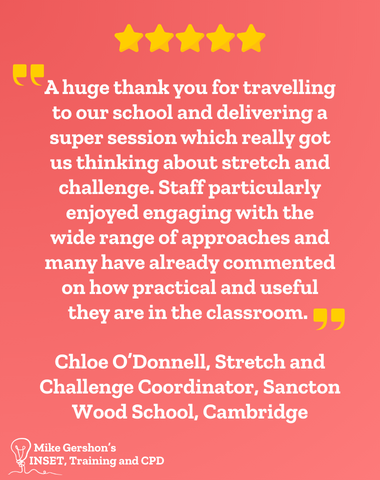
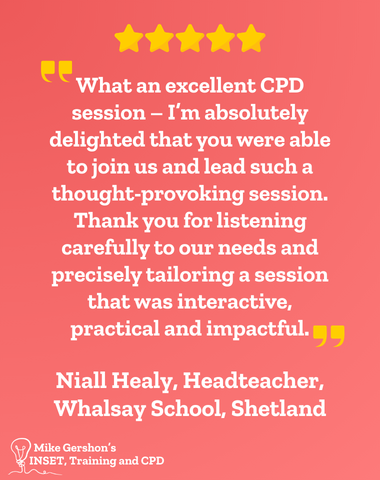
World-Leading Expertise on Practical Teaching and Learning That Works
Five reasons you can rely on Mike to deliver expert training and practical guidance for your staff.

- ✅ Mike has worked with more than 700 schools, delivering inspiring in-person training to over 35,000 teachers.
- ✅ Mike is the author of forty books on teaching and learning, including numerous bestsellers, that have sold in excess of 160,000 copies worldwide.
- ✅ Mike’s teaching resources have been viewed and downloaded more than 4 million times by teachers in over 180 countries and territories.
- ✅ Mike has been working with schools, governments and regional authorities continuously since 2010.
- ✅ Mike has supported over 3,000 teachers online through his bespoke CPD platforms, including Mike Gershon’s Effective Teaching and Learning, the only professional development platform built on Mike’s expertise and prioritising teacher autonomy.
Frequently Asked Questions
Do you do half-day and twilight training?
Yes. I offer both and recognise the flexibility schools sometimes need around their calendars. Half-day and twilight CPD focuses on expert input from me. We remove the teamworking and plenary sessions to accommodate this.
Do you offer follow-up packages?
Yes. Many schools I work with ask me to come back and work with them again, to support them in their developmental journey. Follow-up options include further training, supportive observations with constructive feedback, paired observations and SLT coaching.
We’re a small primary school, can we still work with you?
I always hold back a few dates each year for small primaries, recognising the challenges the smallest schools face in accessing high-quality training. We can also work around tight budgets by looking at online options and in-person training involving multiple schools. The smallest primary I’ve worked with had four teachers – and we had a great day together!
We’d like to look at online training. Is that something you offer?
Yes. It is not my preference as I believe that in-person is always better, and includes elements that can’t be replicated online. However, I do provide online training for schools where in-person may be difficult due to geography, time zones and other factors. My one rule for online is that staff must sit together so that I can facilitate discussion and interaction just as I do when delivering in person.
How far are you willing to travel?
I travel across the UK and overseas from my base in York. Far flung visits have included Shetland, Cornwall, Scotland, Northern Ireland and Pembrokeshire. Even further flung visits have included Romania, Norway, Italy, Bahrain, Kuwait and The Falkland Islands. Trips that require extensive travelling attract a higher cost to cover additional time and mileage.
Can we book you in conjunction with another school?
Yes. Many smaller schools opt for this approach. Sometimes this sees two or three primaries joining up for a full-day session, sometimes a cluster of schools combine budgets and I work with them over an extended period. Occasionally schools ask if they can book me and then sell tickets to the event to nearby schools to cover costs. That is also fine with me.
Is the training relevant for all age groups?
Yes. I have worked with hundreds of primaries, hundreds of secondaries, and dozens of FE colleges over the years. I present in a curriculum agnostic way, using examples that are relevant for the audience in front of me and the age group they teach. A big part of all my training is giving colleagues the opportunity to think about how they can take the ideas and strategies I present and use them with the learners they know best.
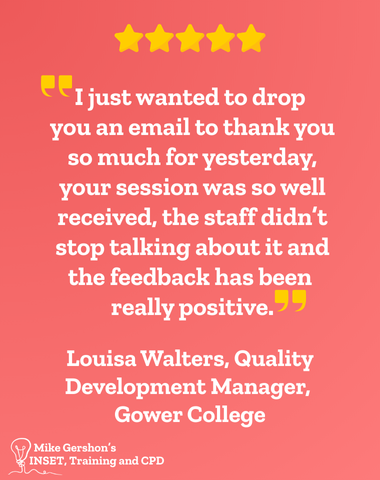

Start Changing How Your Staff Stretch and Challenge Your Learners Today With Mike’s FREE Bloom’s Taxonomy Knowledge Base
Get a head start on developing how you stretch and challenge all learners in your school by exploring my Bloom’s Taxonomy Knowledge Base and sharing it with your staff.

The Knowledge Base features 42 blogs and articles adapted from my bestselling book How to Use Bloom’s Taxonomy in the Classroom: The Complete Guide.
Bloom’s Taxonomy is inherently progressive.
This means we can use it to embed challenge in our teaching and to ensure every learner has their thinking stretched.
(With the caveat that it doesn’t fit quite so well with practical areas of the curriculum.)
You’ll find guides, explanations and practical strategies covering:
- 🎯 Understanding Bloom’s Taxonomy
- 🎯 Knowledge, Comprehension, Application and Analysis
- 🎯 Synthesis and Evaluation
- 🎯 Developing Objectives and Outcomes
- 🎯 Planning Activities and Products
- 🎯 Bloom’s Taxonomy and Questioning
- 🎯 Using the Taxonomy in Assessment
- 🎯 Stretch, Challenge and Bloom’s Taxonomy
Plus I have another FREE bonus for you.
My Challenge Toolkit contains 50 strategies, activities and techniques you and your teachers can use to stretch and challenge all learners, including the more-able.
It’s been viewed and downloaded almost a quarter of a million times by teachers in the UK and around the world.
Secure your copy today to share with your staff and get a head start on developing stretch and challenge in your school.
Enjoy!
P.S. Don’t forget, when I deliver my Stretching and Challenging All Learners training, the emphasis is always on making life simpler and easier for your teachers, so they can adapt, develop and enhance their practice in ways that work.


