
Mike Gershon’s INSET, Training and CPD
The Power of Growth Mindsets

Take Your Staff on a Journey into The Mind and Help Them Understand the Subtle Strategies They Can Use to Change How Learners Think About Learning
- ✅ Cut through the clutter surrounding growth mindsets. Help your staff grab hold of this transformational approach to how learners think about learning, themselves and their classroom experiences.
- ✅ Join Mike on a whistlestop tour of the human brain, as he details some of the fundamental features of our infinitely fascinating evolutionary endowment, and why taking a growth mindset view on learning is a better reflection of how our brains actually work.
- ✅ Understand why the language of your school is the starting point for any shift you want to make in how learners view themselves, the lessons they take part in, and what they believe it’s possible to achieve.
- ✅ Open up the possibility of change for every learner in your school. Let Mike guide your staff through the practical strategies they can use to tweak, modify and adapt the language of their classrooms, so the learners they teach start seeing their abilities, talent and intelligence as neither rigid, fixed, nor immutable.
- ✅ Be inspired by the tried-and-tested techniques Mike shares covering how teachers in the UK and around the world have helped their learners to reconceptualise mistakes and embrace failure as part of the learning process. Techniques your teachers can start using in their classrooms right now.
Some years ago, I attended a wonderful training session by Professor Barry Hymer.
He introduced the concept of growth mindsets and talked about Carol Dweck’s work.
It was an inspirational event.
One that really brought home the power of Dweck’s research to me and everyone else in the room.
At the end of the session I approached Barry and asked if he’d ever considered writing a book about growth mindsets and, if he hadn’t, whether he’d like to work together on one.
Him doing the theory side of things, and me doing the practical side.
He agreed and, a few weeks later, we set to work.
After we published the Growth Mindsets Teacher’s Pocketbook, the response was fantastic.
The marriage of theoretical insights and practical tools went down a storm.
Not long after, I decided to write a second book, How to Develop Growth Mindsets in the Classroom: The Complete Guide.
This went a step further, broadening out the practical focus and giving teachers and leaders everything necessary to transform learner perceptions in their schools.
(I’ve now made this available online, fully updated, as my Growth Mindsets Knowledge Base, which you and your staff can enjoy for FREE.)
It was a big hit and, ever since, I’ve loved delivering training on The Power of Growth Mindsets.
The topic speaks for itself.
It’s inspiring, motivational and instantly relatable.
Because, of course, we all have mindsets of our own.
So when we start thinking about the beliefs that learners have, we can’t help but think about our own beliefs as well.
That’s particularly powerful for helping teachers to reflect on what’s happening in their classrooms.
And to think about what change might look like – for them and for their learners.

Let Mike Help Your Staff Transform Learners’ Self-Perceptions and Attitudes to Learning
A lot has been said and written about growth mindsets over the years.
But, for me, the premise is simple.
How we think about ourselves influences the decisions we take and the choices we make.
If a learner holds a strong belief that they cannot get any better at maths, for example, they are likely to act in line with that belief.
On the other hand, if a learner thinks that maths is hard but that you can get better at it if you persist and apply the feedback your teacher gives you, it’s likely they’ll make different choices.
That’s not to say growth mindsets is a panacea.
It’s not.
Nor does it suggest that all learners can be brilliant at everything if they just start thinking positively.
In fact, it makes a much weaker claim.
But one that is stronger and more believable as a result.
I would summarise it something like this.
- ✅ If you start out with the belief that you can get better at something, you’re more likely to persist, keep putting in effort and enjoy the process, even if it’s difficult, than if you start out thinking the opposite.
John Dryden, titan of English letters, put it better in his translation of Virgil:
- ✅ ‘For they can conquer who believe they can.’
And the great industrialist, Henry Ford, is reported to have phrased it slightly differently as well:
- ✅ ‘Whether you think you can, or think you can’t – you’re right.’
This takes us to the heart of growth mindsets.
We’re thinking about the core beliefs the children and young adults we teach have about themselves as learners.
What they think is possible.
What they believe to be true.
And remember, growth mindsets isn’t saying we need to get every child thinking they can achieve anything, simply through the application of positive thinking.
No.
What we’re saying is that when a child or young adult believes they have the capacity to get better at something – to change and grow – they are likely to take different decisions, make different choices and act in different ways than if they believe the opposite.

Consider yourself as an example.
Think about a time when you really, truly, fundamentally believed you could get better at something.
It didn’t mean that improving was easy.
But it probably did mean you could visualise a positive outcome.
That you could accept negative emotions when they came (like when you got things wrong or the level of challenge ramped up) and then put them to one side and carry on.
Persistence is at the heart of growth mindsets.
When we start with the premise that we believe we can get better at something, it’s easier to persist.
Not easy, but easier.
Persistence is usually hard, at least to some extent.
All of this reflects a key part of what we do in The Power of Growth Mindsets training.
We think about our own experiences and mindsets, as well as those of our learners.
This helps us to understand, in concrete terms:
- ✅ What the research suggests
- ✅ How the concept works
- ✅ And what it looks like in real life.
In my introduction, I’ll help you and your staff to get to grips with all of this.
Together, we’ll reflect on:
- ✅ The nature of how learners think
- ✅ The way in which the brain actually works
- ✅ And, most importantly, the relationship between what a learner believes and how they are likely to act.
For example, a learner who believes intelligence, talent and ability is open to change, is more likely to see effort as a path to mastery.
Whereas a learner who thinks effort, talent and ability are fixed is more likely to see effort as fruitless.
For them, you’ve either got it, or you haven’t.
Once we’ve thought about the nature of our minds and the core ideas at the heart of growth mindsets, we move onto practical strategies, including:
- 🎯 Why language is always the first port of call for anyone looking to develop growth mindsets – whether at classroom level, or across a whole school – and why the choices you make here can have a profound impact on how your learners talk and think about themselves and their learning.
- 🎯 A subtle tweak you can make to your praise that changes the message you are conveying and encourages learners to focus on the process of learning, rather than the end result.
- 🎯 How to use real-life case studies to make growth mindset thinking concrete, accessible and identifiable for your learners, whether they are eighteen year-olds getting ready for exams, or eight year-olds getting ready for the Easter break.
- 🎯 The central feature of all human existence that has the capacity to change or reinforce the beliefs we have about ourselves, and why this makes it almost too easy to send contradictory messages to learners, even when you start out with good intentions.
- 🎯 Why you should start looking at how you talk about mistakes in your school and consider the benefits of breaking up mistakes into different categories, so that learners can think about them more carefully and more meaningfully.
Secure Mike’s The Power of Growth Mindsets Training for Your Staff
Or CALL NOW to secure your dates on 0333 404 7259

A Practical, Pragmatic Approach to Growth Mindsets That Balances Inspiration, Energy and Enthusiasm to Get Your Teachers Firing on All Cylinders
A full-day with Mike gives your staff an understanding of growth mindsets that sets them up to change how learners think and act in their lessons.
Plus, your teachers will gain all the practical strategies they need to start work on this immediately.
Here’s an example of a full-day schedule:
- 9.00 – 10.30: Session 1 – What are growth mindsets?
- 10.30 – 11.00: Break
- 11.00 – 12.30: Session 2 – Bringing the Power of Growth Mindsets Into Your Classroom
- 12.30 – 13.15: Lunch
- 13.15 – 14.30: Session 3 – Implementation Team Working
- 14.30 – 14.45: Optional Break
- 14.45 – 15.15: Session 4 – Sharing Practice, Reflective Plenary
In Session One, we look at the following:
- ✅ What growth mindsets are and how you can use this knowledge to make sense of learner behaviour in your classroom.
- ✅ The central beliefs that learners are likely to have about themselves and their learning.
- ✅ How these beliefs tend to give rise to different actions and behaviours, and why this matters whatever goals you have for your lessons.
- ✅ The difference between a mastery focus and a performance focus, and what this means for how your learners deal with challenges.
- ✅ A whistlestop tour of the human brain and why growth mindset thinking aligns better with how the brain actually works than the alternative.
This lays the foundations and gives your staff an intimate understanding of the most important features of growth mindsets.
From here, we move to practical matters in Session Two, where we focus on three key areas:
- 🎯 The Language of Growth Mindsets
- 🎯 Growth Mindsets Case Studies
- 🎯 Reframing Mistakes and Failure
Across these, we explore around a dozen strategies and techniques you and your staff can use to start developing growth mindset thinking in your school right now.
This is your toolkit for bringing growth mindsets to life and creating the culture of learning you want.
Throughout the morning, you’ll experience a mix of expert delivery and reflective discussion designed to get you thinking critically about your own experiences and the learners you know best.
A balance between authoritative instruction and interactive dialogue is essential to an effective INSET.
It means everyone in the room has the chance to make sense of the ideas we explore, tie them to their own experiences, and think about the tweaks, changes and adjustments they want to make to develop growth mindsets in their own classrooms.
Implementation is Key
After lunch, we get colleagues into teams, working on implementation.
For me, this is crucial.
Staff need the opportunity to translate the ideas and techniques from the morning into their own practice.
While this is happening, I circulate, spending time with each team in turn.
It’s incredible just what colleagues can produce in this timeframe. The quality and depth of work I’ve seen teams create is remarkable.
I always encourage one or more senior leaders to come round with me as I circulate, so they can get a sense of what staff are developing.
Finally, we have the reflective plenary.
I bring everyone back together and teams have the opportunity to share their work with each other in a supportive, collegial atmosphere.
This creates great momentum to carry into the next full week of teaching, and beyond.
It ends the day on a high, and gives staff the confidence and energy to drive forwards with the new ideas, strategies and materials they’ve created.
What is included in a full day of The Power of Growth Mindsets INSET, Training or CPD?
All bookings include:
- ✅ A full day of CPD, as outlined above, with the option to tailor sessions and messages to match the current priorities of your school.
- ✅ Full access to all resources used on the day, including copies of the slides for internal use.
- ✅ The right to film the training and to subsequently store and share this within your school.
- ✅ One-to-one SLT support, either on the day or via TEAMS/phone, in which Mike will walk you through proven strategies for maintaining momentum around Growth Mindsets for 12+ months after the training is finished.
- ✅ A dozen copies of my bestselling book How to Develop Growth Mindsets in the Classroom: The Complete Guide, to share with staff.
For half-day and twilight INSET or CPD, we focus on the expert-led sessions from Mike, and remove the implementation and plenary sessions from the agenda.
Everything else listed above is included in half-day and twilight bookings.
One input from Mike and, if you follow his guidance on how to maintain momentum around developing growth mindsets, you’ll have scope for 12+ months’ sustained impact in your school.
Plus, an exclusive bonus to celebrate the launch of my newly developed CPD platform, Mike Gershon’s Effective Teaching and Learning.
- ⭐ All full-day courses booked in 2026 will receive three complementary one-year memberships to the platform, worth £1,966.
- ⭐ Choose any three members of your school’s leadership team to receive these memberships.
- ⭐ They will gain access to everything on the platform for a full twelve months, including thirty courses covering ten key areas of teaching and learning, practical guides, big picture videos, a growing webinar library, and resources covering how to support ASD learners in mainstream classrooms.
- ⭐ Over 3,000 teachers were part of the first version of the platform. Version two provides a bigger, better, more intuitive experience that three members of your leadership team can enjoy as part of this exclusive, time-limited celebration.
- ⭐ Key areas covered on the platform include Feedback, Metacognition, Differentiation, Scaffolding and Modelling, Independent Learning, Assessment for Learning and more.

World-Leading Expertise on Practical Teaching and Learning That Works
Five reasons you can rely on Mike to deliver expert training and practical guidance for your staff.

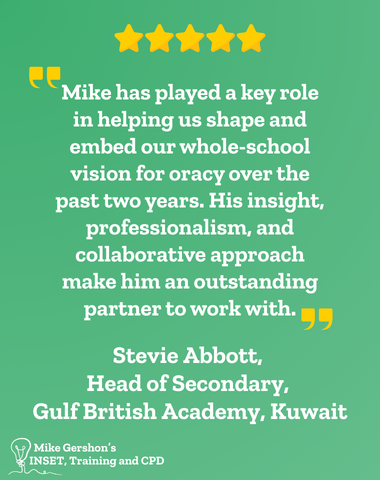
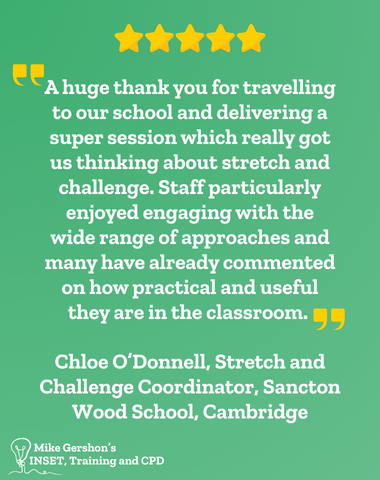
- ✅ Mike has worked with more than 700 schools, delivering inspiring in-person training to over 35,000 teachers.
- ✅ Mike is the author of forty books on teaching and learning, including numerous bestsellers, that have sold in excess of 160,000 copies worldwide.
- ✅ Mike’s teaching resources have been viewed and downloaded more than 4 million times by teachers in over 180 countries and territories.
- ✅ Mike has been working with schools, governments and regional authorities continuously since 2010.
- ✅ Mike has supported over 3,000 teachers online through his bespoke CPD platforms, including Mike Gershon’s Effective Teaching and Learning, the only professional development platform built on Mike’s expertise and prioritising teacher autonomy.
Frequently Asked Questions
Do you do half-day and twilight training?
Yes. I offer both and recognise the flexibility schools sometimes need around their calendars. Half-day and twilight CPD focuses on expert input from me. We remove the teamworking and plenary sessions to accommodate this.
Do you offer follow-up packages?
Yes. Many schools I work with ask me to come back and work with them again, to support them in their developmental journey. Follow-up options include further training, supportive observations with constructive feedback, paired observations and SLT coaching.
We’re a small primary school, can we still work with you?
I always hold back a few dates each year for small primaries, recognising the challenges the smallest schools face in accessing high-quality training. We can also work around tight budgets by looking at online options and in-person training involving multiple schools. The smallest primary I’ve worked with had four teachers – and we had a great day together!
We’d like to look at online training. Is that something you offer?
Yes. It is not my preference as I believe that in-person is always better, and includes elements that can’t be replicated online. However, I do provide online training for schools where in-person may be difficult due to geography, time zones and other factors. My one rule for online is that staff must sit together so that I can facilitate discussion and interaction just as I do when delivering in person.
How far are you willing to travel?
I travel across the UK and overseas from my base in York. Far flung visits have included Shetland, Cornwall, Scotland, Northern Ireland and Pembrokeshire. Even further flung visits have included Romania, Norway, Italy, Bahrain, Kuwait and The Falkland Islands. Trips that require extensive travelling attract a higher cost to cover additional time and mileage.
Can we book you in conjunction with another school?
Yes. Many smaller schools opt for this approach. Sometimes this sees two or three primaries joining up for a full-day session, sometimes a cluster of schools combine budgets and I work with them over an extended period. Occasionally schools ask if they can book me and then sell tickets to the event to nearby schools to cover costs. That is also fine with me.
Is the training relevant for all age groups?
Yes. I have worked with hundreds of primaries, hundreds of secondaries, and dozens of FE colleges over the years. I present in a curriculum agnostic way, using examples that are relevant for the audience in front of me and the age group they teach. A big part of all my training is giving colleagues the opportunity to think about how they can take the ideas and strategies I present and use them with the learners they know best.


Start Changing How Your Staff Think and Teach Today With Mike’s FREE Growth Mindsets Knowledge Base
Get a head start on developing growth mindsets in your school by exploring my Growth Mindsets Knowledge Base and sharing it with your staff.
The Knowledge Base features 29 blogs and articles adapted from my bestselling book How to Develop Growth Mindsets in the Classroom: The Complete Guide.
You’ll find guides, explanations and practical strategies covering:
- 🎯 Key Growth Mindset Ideas and Why Language Matters
- 🎯 Rethinking Mistakes and Failure
- 🎯 How to Effectively Target Learner Effort
- 🎯 The Fundamentals of Giving Great Feedback
- 🎯 How to Get Learners Thinking About Thinking in Your Classroom
- 🎯 Creating a Challenge Culture That Works
- 🎯 What You Can Do To Prioritise the Process of Learning
- 🎯 Engaging Parents with Growth Mindsets
- 🎯 Zero-Planning Growth Mindsets Exemplar Questions
So enjoy – I hope you and your team find it useful!
P.S. Don’t forget, when I deliver training on The Power of Growth Mindsets, the emphasis is always on making life simpler and easier for your teachers, so they can adapt, develop and enhance their practice in ways that work.


